
Tokenomics Fundamentals Series: W5H framework for token design, Part IV - Token supply and demand dynamics
W5H tokenomics framework Part IV: following "Why, When, What, Where, Who and How" for token design, we discuss token supply-demand dynamics

Table of Contents
- Regulating token supply and demand
- Token supply regulation
- Regulating token demand
- Token supply and demand analysis
- What value creation drives the token demand and is it sustainable?
- How will the token supply change, and can the demand match it?
- Case study 1: OlympusDAO and OHM
- Case study 2: Axie Infinity
- Conclusion
- 2026 update
- Emission schedules were rewritten
- Olympus replaced the rebasing era
- Axie changed both the sink and the reward token
- A supply change is only one side of the answer
This article is part IV of the following six-part series:
 Charles Shen, PhD, EMBA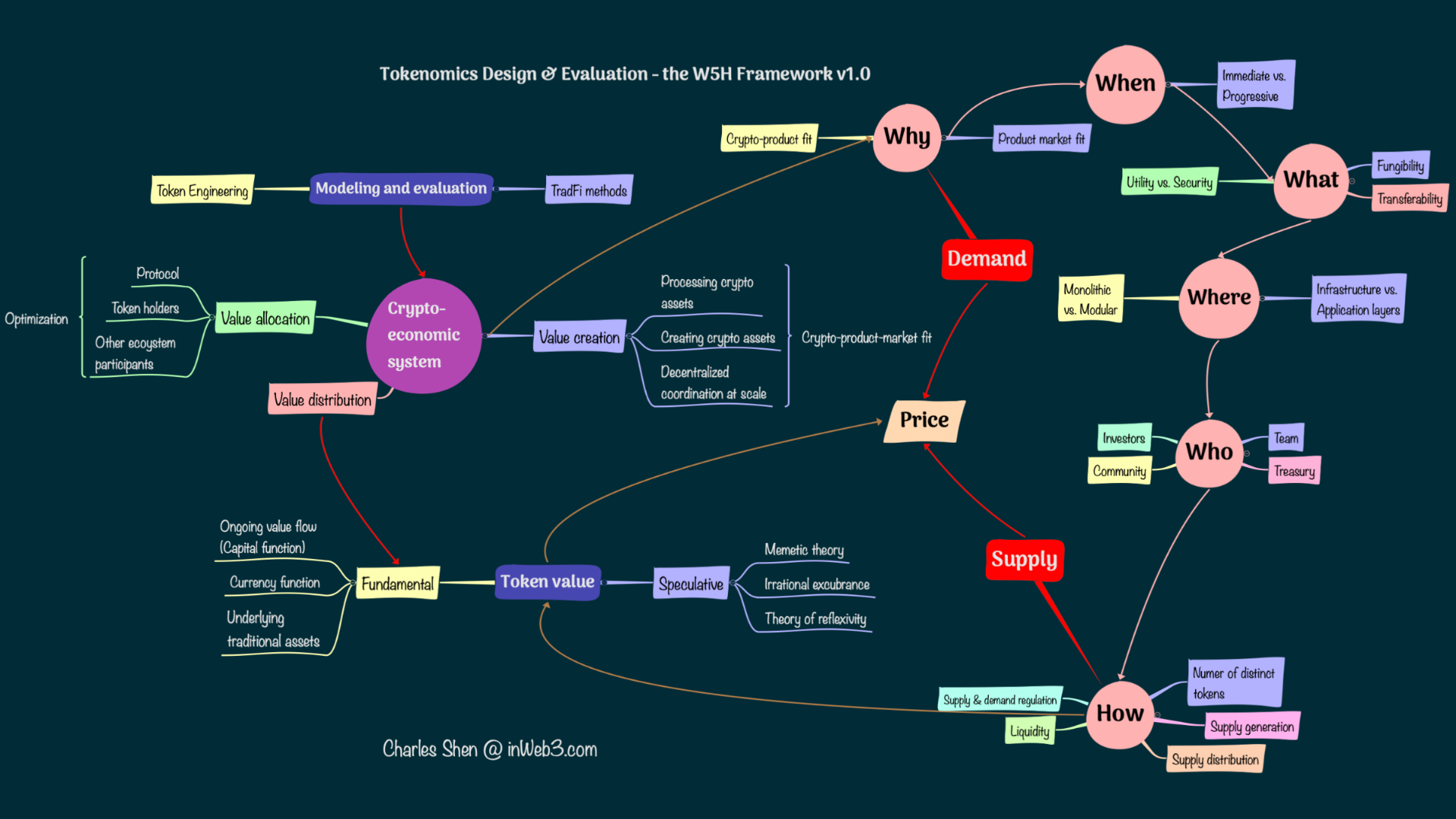
Originally published in January 2023. A September 2026 update follows at the end.
In the prior parts of the series, we discussed the “Why, When, What, Where, Who, and How” of token design.
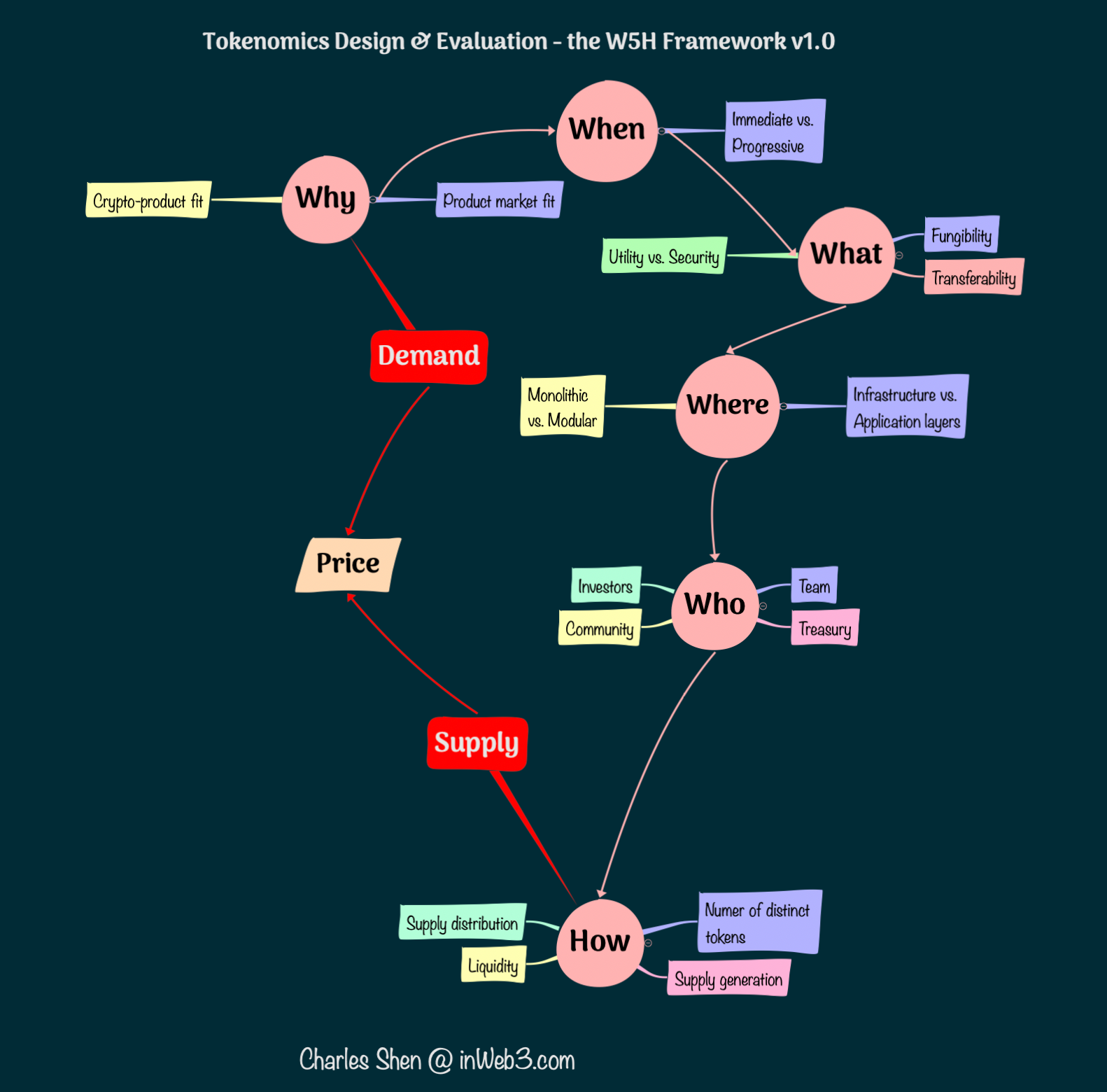 W5H framework for token design (W5H) by Charles Shen @ inWeb3.com
While many of our discussions are in the context of the initial token launch, answers to these questions directly impact the ongoing supply and demand in the ecosystem, which is crucial for the long-term sustainability of the token project. The dynamic equilibrium of supply and demand at the overall business level and the token level determine the prices of goods and services as well as the tokens. They are the remaining critical components that close our W5H loop, and are the focus of this article.
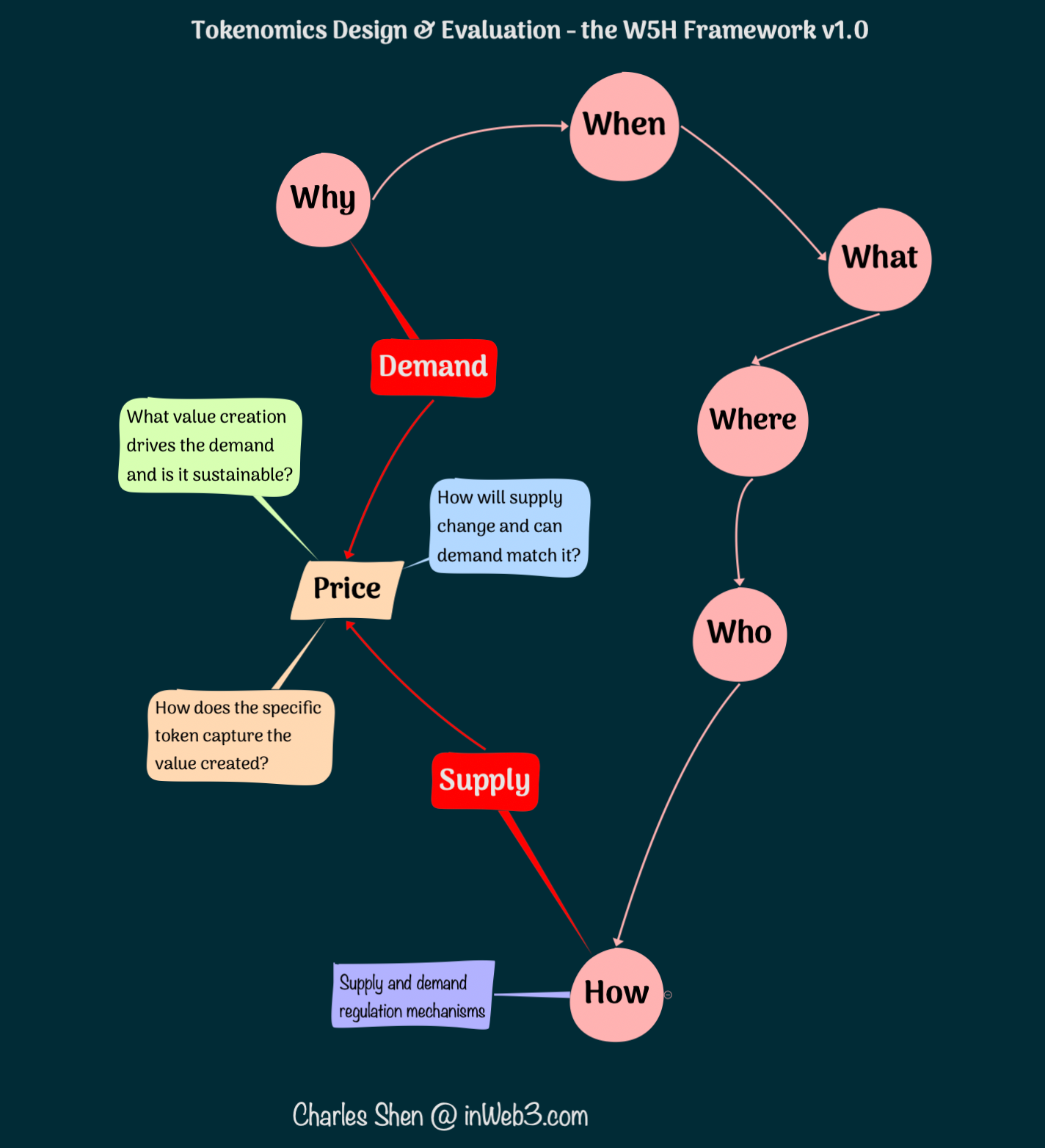 W5H framework for token design (Supply & Demand) by Charles Shen @ inWeb3.com
As usual, we approach the supply-demand dynamics at both the business level and the token level. At the business level, the supply and demand of specific goods and services are actually part of the crypto-product-market fit problem discussed in “Why token”. Therefore, let us elaborate more on the token-level supply and demand mechanisms here.
Regulating token supply and demand
Token supply regulation
Token supply may be regulated through a project’s governance. Recall from our “How” token part that token supply generation can be pre-scheduled or on-demand. If the supply is pre-scheduled, some projects’ governance chooses to modify the original token emission pattern when the situation changes, to adjust the future token supply. If the token minting is demand-driven, there are also things the project’s governance might be able to do to adjust the supply. For example, if a stablecoin is minted based on collateral, lowering the required collateralization ratio or raising a debt ceiling allows more of the stablecoin to be minted; whether supply rises depends on borrowing demand. However, such change has consequences. Lower collateralization ratios bring increased risk to the project’s overall financial status.
While supply regulation could mean both increasing and reducing supply, the more prevalent issue projects encounter is the over-supply of tokens that cannot be sustained by their demand. Let us focus on mechanisms that reduce token supply in more detail.
Temporary supply reduction - locking and vesting
Locking tokens temporarily takes them off the market and reduces the token’s selling pressure during the lock period; depending on the circulating-supply definition, locked tokens may still be counted. A vesting schedule releases the tokens gradually over time, alleviating abrupt supply shocks. The project could set up incentives to encourage voluntary locking by the token holders. The more real value these incentives bring to the users; the more effective the mechanism could be. For example, the well-known veCRV model of Curve Finance locks the CRV token for up to four years in exchange for governance rights and for sharing ongoing protocol fees. Derivative protocols built on the veCRV mechanism, such as Convex, even turn the locking of CRV from temporary to permanent, further tightening the token selling pressure.
Note that the more tokens locked does not necessarily mean the more valuable the token becomes. For example, if a token serves as a medium of exchange for goods, and nobody can get the token because all tokens are locked, then the exchange for goods cannot happen, and the overall crypto economy would not even exist.
Permanent supply reduction - burning tokens
Burning existing tokens can permanently remove them from the circulating supply. It artificially introduces a deflationary force to counter the token’s inflationary pressure and potentially improve token value. Common token-burning mechanisms try to tie the burning process with the token demand. One approach is to burn tokens when users spend them on the protocol’s services. ETH’s EIP1559 implementation burns part of transaction fees. BNB has a similar real-time partial transaction fee burning. The Graph protocol that provides blockchain data query services also burns about 1% of query fees and protocol deposit taxes paid by curators and delegators.
When the burning mechanism is meant to counter token inflation, designing the right parameters to strike a real-time token supply-demand balance could be very challenging because of unpredictable factors in the economic system. One approach people use is to periodically assess the demand condition to decide how much supply should be reduced, then buy back and burn them. The BNB token’s quarterly Auto-Burn, e.g., calculates the burn from the average BNB price and the number of BNB Chain blocks produced during the quarter, which means that more tokens will be burned if the price of BNB declines.
Smoothing and reduction of future token supply
Supply smoothing and reduction may also be applied to tokens not yet released.
- Tokens scheduled for future release typically adopt a relatively smooth emission pattern rather than a step function-based inflation leap. Convex protocol’s pre-scheduled CVX token emission is an example of a smooth minting curve with a reduced inflation rate. For tokens that are designated for specific participants, especially those at low or zero cost for investment or rewards, a norm is to enforce a mandatory lockup and vesting period. For instance, teams and VCs typically receive their allocated tokens after a locked period of less than one year to a few years. These tokens are usually vested gradually in 1 to 3 years. Similar locking and vesting can be applied to token rewards earned by yield farming, e.g., as in the DeFi Kingdom game.
- We have also seen projects adjusting their future release schedule to explicitly cut emissions. E.g., the Sushi token started with an infinite inflation schedule. Later its governance deemed it too aggressive and approved a 250M hard cap for the token. The Cosmos 2.0 whitepaper released in September 2022 proposes changing the ATOM token’s long-term emission schedule from an exponential expansion to a more contained linear schedule. But it also requires a significant short-term increase of token emission and was rejected along with other amendments.
Regulating token demand
Handling supply and demand dynamics does not have to be limited to the supply side. It is possible to stimulate or suppress demand in response to changing supplies caused by external factors. The DAI savings rate mechanism of MakerDAO offers a good example. In a basic scenario of MakerDAO’s DAI stablecoin, people deposit their ETH tokens as collateral to mint DAI, increasing DAI supply. In a crypto bull market, people are more likely to take on ETH leverage to mint DAI, resulting in more DAI supply and relatively weaker DAI demand. At such times, the protocol may reward people for holding DAI by raising the DAI savings rate, thus increasing the DAI demand to bring the supply-demand relationship towards a more balanced position. In a bear market where people prefer more stability of holding DAI, the demand is stronger than the supply of DAI because people tend not to leverage ETH to mint DAI. In response, the protocol can reduce the DAI savings rate, practically discourages people from holding DAI, and suppresses its demand.
Token supply and demand analysis
We can ask three common questions when examining token supply-demand dynamics and the resulting token price. Two of them will be discussed in this section, and the third one on token value capture will be covered in the next part of this series. We also select two symbolic projects from the recent crypto market cycle to illustrate the application of the presented questions.
What value creation drives the token demand and is it sustainable?
We temporality ignore the supply side when addressing this question. The system should have sound fundamentals that support a consistent and increasing demand for the token. We can review our answer to the “Why token” question, diving deeper into the token project’s business model and its value creation process. Are there meaningful services and products that produce revenue? Where does the revenue actually come from? Is the revenue sustainable? How do the revenues compare with the costs?
- If a system is not financially sustainable yet but provides meaningful services, it could still be successful. Just like companies in the tech world that are losing money during the growth period. These projects could receive external funding (primarily from VCs) that helps them through those early periods. Of course, there is no guarantee that such projects will indeed prevail; many of them inevitably fail.
- If a system seems profitable but relies primarily on a constant influx of new user funds to sustain its business model, that should raise a flag for potential “ponzinomics”.
How will the token supply change, and can the demand match it?
If the crypto project passes the fundamental demand drive test under a given token supply, we still need to check whether the changing token demand and supply can achieve a healthy balance.
If supply decreases, it should help push the price higher in the short-term given similar demand. But if supply decreases too much, it might stifle the demand and harm the overall economy. Therefore, many token economies are designed to have moderate supply inflation. This inflationary supply can either follow a pre-determined schedule or be released “on demand.” Let us look at what could happen to the new token supply:
- People may sell them on the market and cash out; this is the least wanted case since it indicates higher supply and lower demand, which pushes the price down.
- People may hodl the token for the long term. This behavior is desired as it signals higher demand and keeps the new supply off the market for the time being, reducing selling pressure.
- People may spend the new tokens on a service that burns them (when applicable). This outcome also represents demand for the token and is highly desirable since it essentially negates the extra supply and minimizes the dilution from the new supply.
- Other user behaviors could lead to various degrees of demand impact in between the ones listed above.
If aggregate impact from user demand consistently falls short of matching up with the supply, the economy could fall into a hyperinflation mode and lead to a token price crash.
Case study 1: OlympusDAO and OHM
OlympusDAO is a representative project for DeFi 2.0. It aspires to “create a decentralized, censorship-resistant reserve currency for the emerging Web3 ecosystem”. Its OHM token intends to preserve purchasing power, maintain deep liquidity, and serve as a unit of account and a store of value reserve. But unlike crypto stablecoin projects, the OHM token is not pegged to Dollar. Instead, it is backed by assets such as the decentralized stablecoin DAI. The change from “pegged” to “backed” is significant. It means OHM has a free-floating value, but its intrinsic value is its underlying backed asset.
What is the primary value that draws users to the OHM token?
When OHM was launched in early 2021, its immediate demand driver was not its status as currency because it was yet to be adopted. Instead, it offered a passive earning APY as high as six figures for staking OHM. Even in mid-2022, the APY was still at the middle three figures level. The incredible APY, along with its (3,3) meme, were the main factors people bought and staked OHM at the time.
Where does the yield of OHM come from, and is it sustainable?
A deeper look into the protocol reveals that the early APY was paid by minting and distributing new OHM through rebases; the treasury that supported those emissions grew mainly through bond sales to buyers willing to pay far more than the one DAI-backed intrinsic value. But why would people be willing to pay a much higher price, which at the top reached $1415 in April 2021, knowing the intrinsic value is backed by roughly $1? Some users may think the project’s future growth, including the massive treasury assets the protocol controls through the bonding mechanism, is worth the premium. Others may FOMO into it because of the (3,3) meme. If everyone does cooperate and buys only, the price keeps going up. If the price keeps increasing, getting in early gives you a better price and a higher share of the protocols’ value accrual. The only problem is, for the price to keep going up, there need to be unlimited new buyers entering the system. When the new buyer inflow stops, the system turns into Ponzinomics rather than Tokenomics. Jordi Alexander from Selini capital has more insights on this topic.
Summary:
Overall the Olympus protocol has some impressive design, with an ambitious goal and a once wildly popular meme. Unfortunately, its model lacks a sound fundamental and is not sustainable. In hindsight, it should not be too surprising to see the OHM unit price fall by over 99% from its ATH. Because staked OHM balances rebased, that unit-price decline does not equal every staker’s investment loss.
Nevertheless, the Olympus project has also produced some impactful innovations, especially the concept of protocol-owned liquidity, which is considered a key characteristic of DeFi 2.0. The protocol reported about $207M of treasury assets at year-end 2022.
Case study 2: Axie Infinity
Axie Infinity is an NFT-based blockchain game. Players battle, collect, and trade NFT digital pets called Axies. It is the symbol of play-to-earn games.
What is the primary value that draws users to the Axie Infinity game and its tokens?
Many players were attracted to Axie Infinity for the prospect of earning income. A May 2021 Twitter poll conducted by the game developer indicates that 48% of the nearly 1000 respondents are in for the “Economy” vs. only 15% for the gameplay. That means a large proportion of the participants are looking for a job, not for a game.
Where do the earnings from the game come from, and is it sustainable?
If people are in the game to earn, where does that money come from? Unfortunately, the early Axie Infinity economy does not generate self-sustaining revenues. It requires players to pay an upfront amount to buy the gaming NFTs to start playing. At its peak, the price tag for the entry NFTs ranges from hundreds to over $1K. The continuous influx of new users paying the cost to join the game has been what supported a token price level that allows existing players to cash out and earn a meaningful income. However, it’s impossible to expect an unlimited number of new users to join the system at an increasingly higher price tag. When new user growth slows down, the token price drops, and existing “worker” players cannot earn enough to make a living. They may leave the game, causing a downward spiral. In short, the demand side fundamental of the game does not pass the sustainability test.
How will the token supply change?
The Axie Infinity game has been acclaimed for providing low-income communities with a play-to-earn model to make a living. That is indeed a worthy cause. A guild-based scholarship mechanism is also created to help onboard more users who cannot afford the game entry NFTs. The idea is to let them play with guild-owned NFTs and split the token earnings with the guild and scholarship manager. This mechanism worked and effectively brought in a large number of users to the game. At one time, an estimate attributed to Sky Mavis’s COO put scholars at 60%-65% of Axie players.
However, so many new users entering the system also means accelerated token supply, e.g., people winning more of its SLP tokens in the game. This situation adds to the existing inflation pressure caused by bots that further push the minting of more tokens in the game.
Can token demand match the supply change?
On the demand side, users can sell the earned SLPs and cash out. Selling does not mint new SLP; it puts already-minted tokens onto the market. The users can also spend those SLPs to breed Axies. That will burn and deflate SLP tokens. Therefore, the outcome will be determined by the comparable speed of SLP inflation vs. deflation. An analysis of SLP minted vs. burned by NAAVIK shows that after August 2021, the SLP minting speed has been faster than its burning speed, and the mint/burn ratio continued to accelerate. Apparently, the deflation power is not strong enough to offset the increasing supply. This phenomenon is probably not surprising if we recall that most of the scholars and low-income players treat the game as a job to win the SLP tokens and sell them for cash earning. They are mainly using the inflation route, not the deflation path.
 Source: CoinGecko and NAAVIK
If we look at the price of the SLP token and its market cap, the summer of 2021 marked the descent: SLP reached an all-time high of about $0.40 on July 13 and fell sharply through August and September. This pattern suggests that the game suffered severe token-supply inflation.
 Source: CoinGecko and NAAVIK
Balancing a game economy has never been an easy task. Solving the in-game SLP hyperinflation issue requires the designers to reduce the token inflation source and/or increase the deflation sink. But these decisions often bring dilemmas. Reducing the number of SLP token rewards also changes the incentives for players and could affect their engagement. On the other hand, raising the SLP cost of breeding could burn more SLP, but higher breeding costs can slow the creation of new Axies and increase the barrier for new players to join.
To their credit, the team publicly acknowledged these problems and has been working in various directions to improve them. They addressed the hyperinflation problem by making it more difficult to earn SLP tokens and imposed further control on the number of Axies. For the fundamental question of actual revenue generation, they listed several options on the Axie Economy & long term sustainability page. They also released a free-to-play version of the game as part of those efforts, potentially onboarding more people from the broader player community and earning revenue from in-game items.
Conclusion
This article follows our prior coverage of the “Why, When, What, Where, Who, and How” of token design, and explored the dynamic equilibrium of supply and demand that closes the W5H loop. Since supply and demand dynamics at the business level is part of the prior “Why token” discussion, we looked at various ways to regulate supply and demand at the token level in this article. Using two symbolic crypto projects as case studies, we also elaborated on two questions covering both the business and token levels, that help examine the supply and demand relationship of a given crypto project.
One remaining question we have not delved into is the connection between the two levels. Specifically, how the value created at the business level accrues to the token level. This is a key aspect of tokenomics design that impact the valuation and pricing of the tokens. It will be our topic in the following part of this series.
This article is part of the six-part W5H framework for token design series, as listed below:
- Part I: W5H overview and Why Token
- Part II: When, What, Where, Who token
- Part III: How token
- Part IV: Token supply-demand dynamics (this article)
- Part V: Token value accrual
- Part VI: Token value assessment
2026 update
The projects in this article have spent the years since January 2023 changing the same supply and demand levers discussed above. Several reduced or ended emissions. Others replaced a headline reward mechanism with a more controlled one. Their experience reinforces a practical point: token supply policy is an operating system that governance keeps tuning, not a chart published once at launch.
Emission schedules were rewritten
Synthetix is one example. Its earlier monetary policy moved from a fixed supply to inflation, then toward a terminal inflation rate. In December 2023, governance implemented SIP-2043 and ended SNX inflation. Synthetix explained that the inflationary rewards had become less effective as an incentive and shifted the system toward trading fees and potential buyback-and-burn mechanisms. The policy changed because the original incentive no longer justified its dilution.
Cosmos took a narrower path after rejecting the broader ATOM 2.0 proposal discussed in the article. Proposal 848 passed in November 2023 and reduced ATOM’s maximum annual inflation from 20 percent to 10 percent. The change remained contentious because lower inflation also lowers rewards paid to validators and delegators. A 2025 Cosmos Labs research request described the operating range as 7 percent to 10 percent and called for further modeling of validator economics, demand, and revenue. Cutting supply growth is not free; the security budget is one of the demands that new issuance pays for.
These examples support the method in the original article. An emission change should be evaluated on both sides: how much sell pressure it removes and which behavior, service, or security it stops funding.
Olympus replaced the rebasing era
The Olympus model discussed above is no longer the six-figure-APY system that made the project famous. Its documentation now classifies the old staking design as legacy and states that rebasing has been switched off. Rebasing no longer changes staked balances.
The current design manages supply in two directions. Treasury yield can fund a yield repurchase facility that buys and burns OHM; the facility can also borrow against the backing of purchased OHM to increase its purchasing capacity. An emissions manager can issue OHM when the token trades above a premium threshold, subject to its rules. Holders can also borrow against OHM through Cooler Loans. Whether the resulting asset is attractive is a separate investment question. The tokenomics lesson is that the unsustainable rebase incentive was replaced by a policy that responds to the relationship among treasury assets, market price, and supply.
Axie changed both the sink and the reward token
Axie Infinity continued experimenting with the SLP imbalance described in the case study. In January 2024, the team announced a 44 billion SLP supply cap, enforced through game emissions and a social commitment rather than by changing the token contract. It also described a stability fund intended to buy or sell SLP when inflation moved away from its target.
Bot farming remained a problem. By January 2026, the team said it had removed SLP farming because emissions were accelerating too quickly and introduced bonded AXS, or bAXS, as an account-bound reward designed to favor real participants. The project’s bAXS launch explanation says that bAXS is backed one to one by AXS, cannot be transferred between accounts, and can be converted to AXS subject to a fee that depends on the player’s standing. In the eighteenth season of Axie Origins, rewards were paid in bAXS.
This redesign attacks the sell-pressure problem at its source. A transferable reward can be farmed and sold immediately. An account-bound reward keeps more of its use inside the game and makes extraction depend on the participant’s record. It also creates new tradeoffs around exit rights, reputation measurement, and control by the game operator.
A supply change is only one side of the answer
All four cases changed supply because the demand created by the product did not justify the old issuance rule. Synthetix ended an incentive that had lost effectiveness. Cosmos reduced dilution while continuing to debate how validator security will be funded. Olympus replaced rebasing with treasury-linked mechanisms. Axie changed both its emissions and the form of its game reward.
None of those actions guarantees demand. Lower inflation, a burn, or a cap can reduce sell pressure, but the system still needs users who value the underlying service. The two questions in the original analysis therefore remain the right pair: what creates sustainable demand, and can that demand absorb the supply required to operate the system?
Related Articles
Tokenomics Fundamentals Series: W5H framework for token design, Part VI - Token value assessment
W5H tokenomics framework Part VI: token value assessment through TradFi modeling and their caveats, and a brief introduction to Token Engineering.
Tokenomics Fundamentals Series: W5H framework for token design, Part V - Token value accrual
W5H tokenomics framework Part V: token value accrual through universal and selective economic value distribution in crypto-economic systems
Tokenomics Fundamentals Series: W5H framework for token design, Part III - How Token?
W5H tokenomics framework Part III: following the prior "Why, When, What, Where, and Who" for token design, we continue to explore "How token".